Turn limit and time limit
Normally a match is won by reaching the Goal and arriving at a bank. With a Turn limit or a Time limit you can instead stop the match after a fixed number of turns or minutes, and whoever has the most net worth at that moment wins. It suits a short evening, or a stream or event that has to end at a known time.
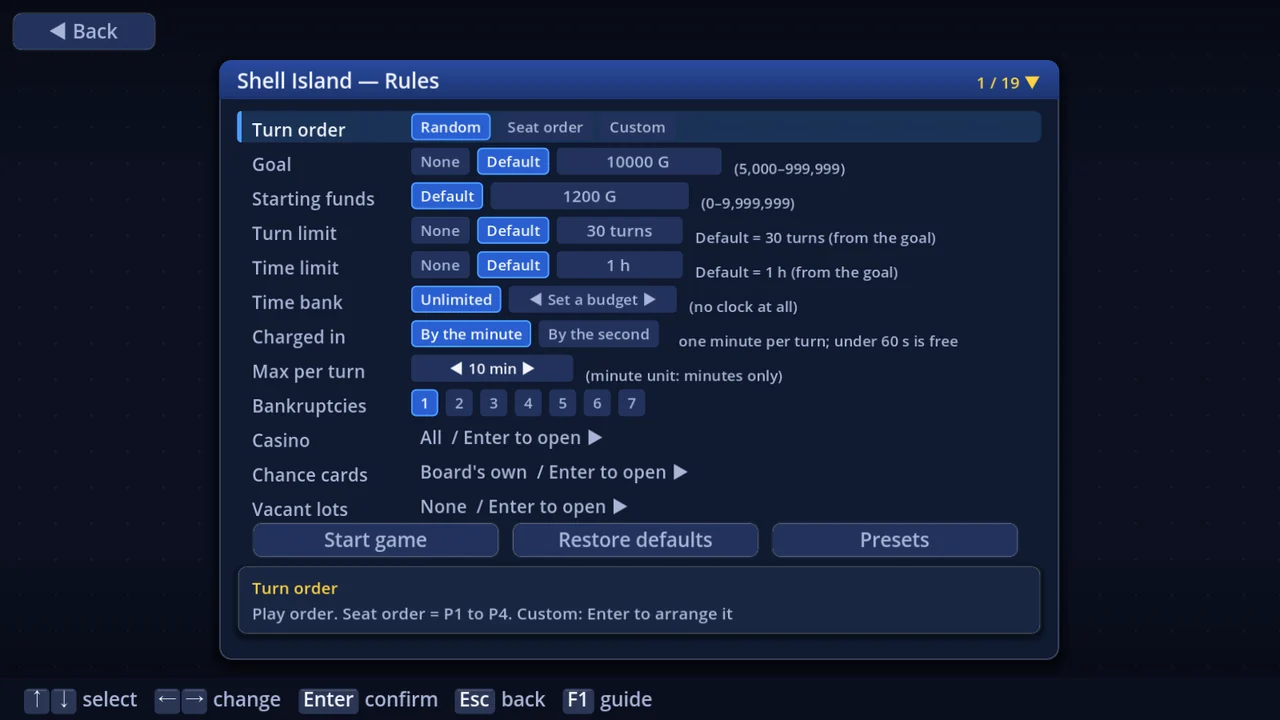
Both are rows on the rule settings (press R on the board list). If you touch neither, a match ends exactly as before — by the Goal alone.
1. Three ways a match can end
How a match ends is decided by three switches. They are independent, and the first one to trigger ends the match.
| Goal | Turn limit | Time limit | How the match ends |
|---|---|---|---|
| On | Off | Off | Reach the Goal and a bank (the usual game) |
| On | On | Off | Reach the Goal / the chosen number of turns is up — richest wins |
| On | Off | On | Reach the Goal / the round in which time ran out ends — richest wins |
| On | On | On | Whichever of the three comes first |
| Off | On | Off | The chosen number of turns is up — richest wins |
| Off | Off | On | The round in which time ran out ends — richest wins |
| Off | On | On | Whichever comes first |
| Off | Off | Off | Not allowed (the only ending left would be bankruptcy) |
- Bankruptcies still end the match in every combination
- The Goal can be set to None only while a Turn limit or a Time limit is set. Put both back to None and the Goal returns to its previous value by itself
- Even with a limit running, reaching the Goal and a bank wins on the spot (a limit is only checked between rounds, so the Goal always settles first)
2. Turn limit
The Turn limit ends the match once everyone has taken this many turns.
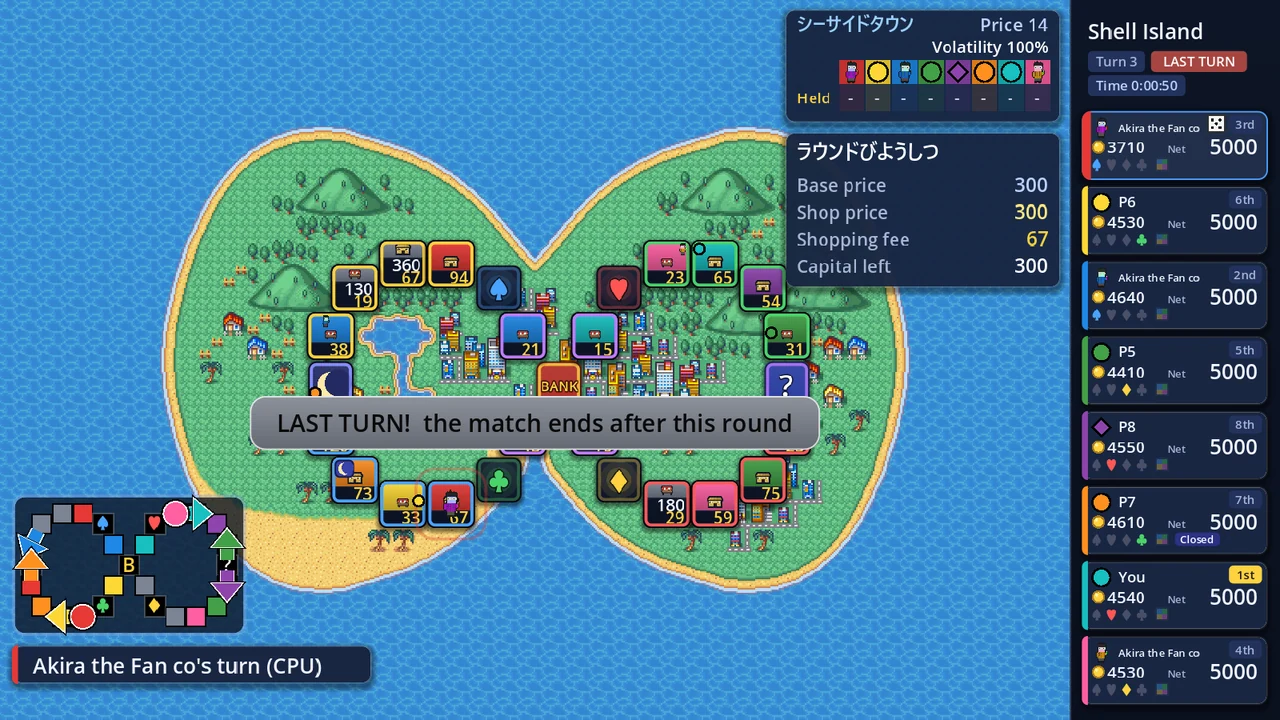
- A turn is one lap — everybody takes one move, the same count the "Turn" chip on screen uses
- The row is None / Default / a number (5–999 turns). Enter types a number (typing 0 gives Default)
- A rest turn, and the place of a bankrupt seat, still count as one move each. A lap always advances by the number of seats, so the match ends with everyone having had the same number of moves
During a match the top of the sidebar shows "N turns left". It turns yellow at 3 turns or fewer and red at 1.
When the final lap begins, a "LAST TURN! the match ends after this round" banner crosses the board and the sidebar chip becomes "LAST TURN". The match ends as soon as everyone has finished that lap.
3. Time limit
The Time limit is a clock for the whole match. The match ends at the end of the round in which the clock reaches 0.
- The row is None / Default / minutes (5–999 min). Enter types a number
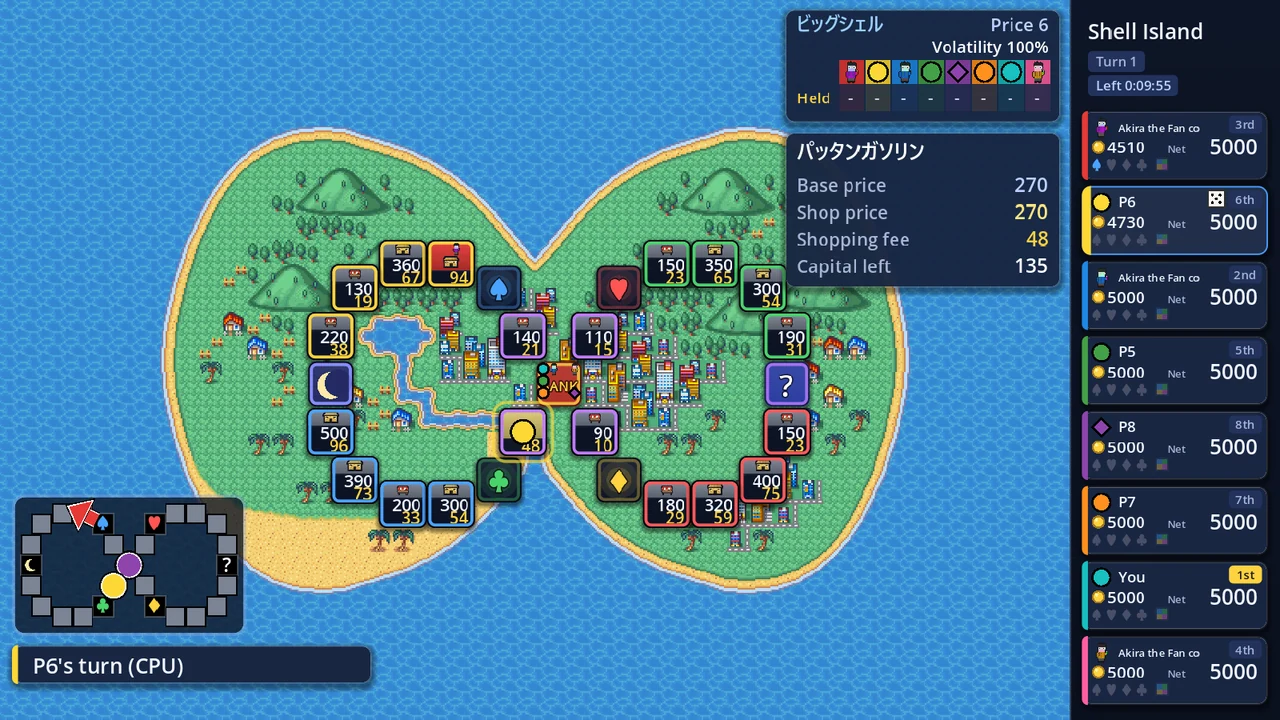
- While the clock runs, the "Time" line in the sidebar becomes "Left 0:09:55". It turns yellow at 5 minutes and red at 1
- The clock stops while paused and after the match is over. If you suspend and come back, it carries on from where it was
3a. What happens at zero
Reaching zero does not end the match on the spot. The lap in progress is played out by everyone. The match ends the moment the next lap would begin, and the player with the most net worth wins.
- From the moment time runs out, the "LAST TURN" banner appears (the same one the Turn limit uses)
- Everyone has had the same number of moves, so nobody wins just by being in front when the clock happened to stop
- The CPU knows about the last turn too and plays the final lap with the end in mind
4. Stopping stalling — Time bank and Max per turn
With a Time limit alone, the player in front could drag out their own turns until the clock ran out. These four rows are what stops that. Setting a Time limit also fills in Max per turn for you (10 minutes by default).
| Row | What it decides |
|---|---|
| Time bank | The time one player may use over the whole match. Unlimited means no clock (the default) |
| Charged in | By the minute = a minute comes off for every whole minute of your own turn (a part-minute is free) / By the second = only the time actually used |
| Max per turn | How long one turn may take. When it runs out, the CPU plays that one turn for you |
| Grace when empty | The allowance per turn once the Time bank is gone (120 seconds by default) |
- When time runs out, the CPU (relief) plays that one turn only. You are back on your next turn — your seat does not disappear and the match does not end
- The clock runs only on a person's own turn. It does not run for CPU seats
- It does not run while someone else is answering (an auction bid, a negotiation reply, a stock offer), or while paused
- A casino mini-game, or selling things to cover a shortfall, also happens on your own time; if it runs out, the CPU carries on
- Time bank and Max per turn work without a Time limit too (for a match that just has a clock)
- When charging by the minute, Max per turn can only be set in whole minutes
5. Who wins
When a limit ends the match, the winner is decided like this:
- The player with the greatest net worth (cash + shops + stock)
- A tie goes to the lower seat number
- In team matches, teams are compared by their combined net worth
- Bankrupt players are not in the running
The winner is announced with "turn limit, richest player" or "time up, richest player" beside the name.
6. The Default numbers
Choosing Default gives the board's own number if it sets one; otherwise it is worked out from the Goal (the row shows "Default = …").
| Goal | Turn limit |
|---|---|
| up to 10,000G | 30 |
| up to 12,000G | 36 |
| up to 14,000G | 42 |
| up to 16,000G | 48 |
| up to 18,000G | 54 |
| up to 20,000G | 60 |
| up to 22,000G | 66 |
| Goal | Time limit |
|---|---|
| up to 10,000G | 60 min |
| up to 12,500G | 75 min |
| up to 15,000G | 90 min |
| up to 17,500G | 105 min |
| up to 20,000G | 120 min |
| up to 22,500G | 135 min |
| up to 25,000G | 150 min |
Above 10,000G the Turn limit grows by 6 for every 2,000G and the Time limit by 15 minutes for every 2,500G (both rounded up; the ceiling is 999).
⚠ Nothing is limited unless you choose a value. Even if the board carries a number, a row left on None plays as an ordinary match.
7. Ways to use it
- A 30-turn sprint — Turn limit 30, Goal None. Compete on net worth over a fixed number of laps
- A match that ends within the hour (good for streams) — Time limit 60 min. Max per turn is filled in for you
- Both a Goal and a limit — set both, and whichever arrives first ends it
- Online play — a custom room's host sets the same rows. In a room, a Turn limit or Time limit below 5 is rounded up to 5, and the Time bank starts from the room's defaults (10 minutes, 120 s grace) → see the Online play guide
Once a match has started, these rules cannot be changed (you can read them in-match under Data → Rules).